Loading...
Loading...
Size: 10mg
Cellular Peptide
In stock · Ships same day · Free shipping over $150
Technical specifications
Molecular Profile
Synthetic 11-amino-acid peptide derived from the helix-B region of erythropoietin.
Storage Requirements
Lyophilized (powder)
-20°C · stable long-term
Reconstituted / in solution
2-8°C · use within 30 days
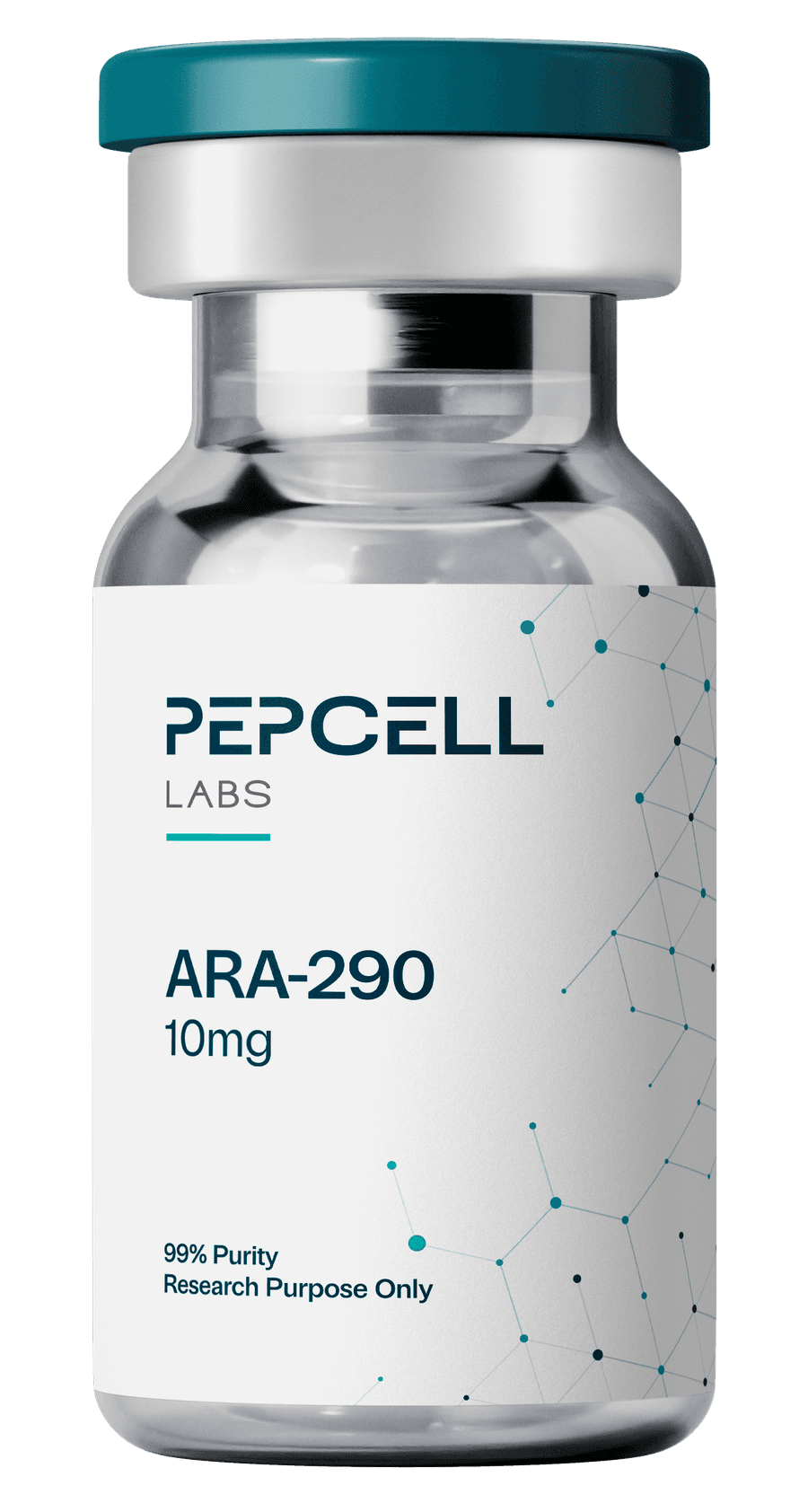
ARA-290 (also known as cibinetide) is an 11-amino acid synthetic peptide (sequence: HBSP, helix B surface peptide) derived from the three-dimensional structure of erythropoietin's helix B surface region. It selectively activates the innate repair receptor (IRR), a heterodimer composed of the erythropoietin receptor (EPOR) and the beta common receptor (betaCR2/CD131), which is expressed on monocytes, macrophages, Schwann cells, and endothelial cells in damaged or inflamed tissues. Critically, ARA-290 does not bind the classical homodimeric EPOR responsible for erythropoiesis, meaning it provides tissue-protective and anti-inflammatory effects without stimulating red blood cell production or the thrombotic risks associated with erythropoietin administration. Published clinical research in sarcoidosis patients demonstrated improvements in small fiber neuropathy symptoms and corneal nerve fiber density, while preclinical models have shown neuroprotective effects in diabetic neuropathy and reduced inflammatory cytokine production. ARA-290 represents a mechanistically unique approach to tissue repair — leveraging the cytoprotective signaling of the EPO pathway without its hematopoietic effects. Ongoing research is exploring applications in chronic neuropathic conditions, metabolic tissue damage, and inflammatory disorders where the innate repair receptor pathway is upregulated.
Selectively activates the innate repair receptor (EPOR/betaCR2 heterodimer) expressed on tissue-resident macrophages, Schwann cells, and endothelial cells at sites of injury or inflammation. This receptor is distinct from the classical erythropoietin receptor, allowing ARA-290 to trigger cytoprotective PI3K/Akt signaling without stimulating red blood cell production.
Reduces production of pro-inflammatory cytokines including TNF-alpha, IL-6, and IL-1beta through modulation of macrophage polarization from M1 (pro-inflammatory) to M2 (anti-inflammatory/reparative) phenotype. Preclinical research demonstrated significant reductions in systemic inflammatory markers and tissue damage in multiple organ injury models.
Clinical studies in sarcoidosis patients demonstrated improvements in small fiber neuropathy symptoms and increased corneal nerve fiber density after ARA-290 administration. Preclinical diabetic neuropathy models showed enhanced Schwann cell survival and nerve fiber regeneration, suggesting a direct neurotrophic effect mediated through innate repair receptor signaling.
Published research protocols reference daily subcutaneous administration. Store refrigerated at 2-8°C.
Every batch is independently analyzed by a third-party laboratory for purity and identity before release. A batch-specific Certificate of Analysis (COA) is available for each lot.
Purity
99.7%
Lab
Janoshik Analytical Laboratory
Batch
ARA290-2025-001
Test Date
2025-02-18
Orders placed before our daily cutoff ship the same business day. Free shipping on orders over $150, with tracking emailed as soon as your order leaves our facility.
Shipment protection covers your order against loss or damage in transit — if a protected order is lost or arrives damaged, our support team will arrange a replacement or resolution.
For in-vitro research and laboratory use only. This product is not a drug, supplement, food, or cosmetic, and has not been evaluated by the FDA.
Use is restricted to qualified researchers and laboratories operating within all applicable institutional, legal, and ethical guidelines. By purchasing, you confirm you are acquiring this product solely for lawful research purposes.
ARA-290 selectively activates the innate repair receptor (EPOR/betaCR2 heterodimer) without binding the classical homodimeric EPOR that stimulates red blood cell production. This means ARA-290 provides tissue-protective and anti-inflammatory signaling without erythropoiesis, eliminating the thrombotic and polycythemia risks associated with EPO administration.
ARA-290 (cibinetide) has been investigated in Phase 2 clinical studies in patients with sarcoidosis-related small fiber neuropathy. Published results demonstrated improvements in neuropathic symptoms and corneal nerve fiber density. Additional preclinical research has explored its effects in diabetic neuropathy, cardiac ischemia-reperfusion injury, and chronic inflammatory conditions.
Reconstitute lyophilized ARA-290 with bacteriostatic water by slowly injecting along the vial wall. As a short 11-amino acid peptide, ARA-290 dissolves rapidly. Store unreconstituted peptide at -20°C; after reconstitution, refrigerate at 2-8°C and use within 30 days. Minimize freeze-thaw cycles.
Each ARA-290 batch is independently tested at Janoshik Analytical Laboratory using HPLC for purity determination and mass spectrometry for sequence identity confirmation. Current batches test at 99.7% purity, with batch-specific Certificates of Analysis available on the product page.
ARA-290 is sold exclusively for in-vitro research, laboratory investigation, and educational purposes. While cibinetide has been studied in clinical trials, this research-grade product is not an FDA-approved drug and is not intended for human consumption or self-administration.