Loading...
Loading...
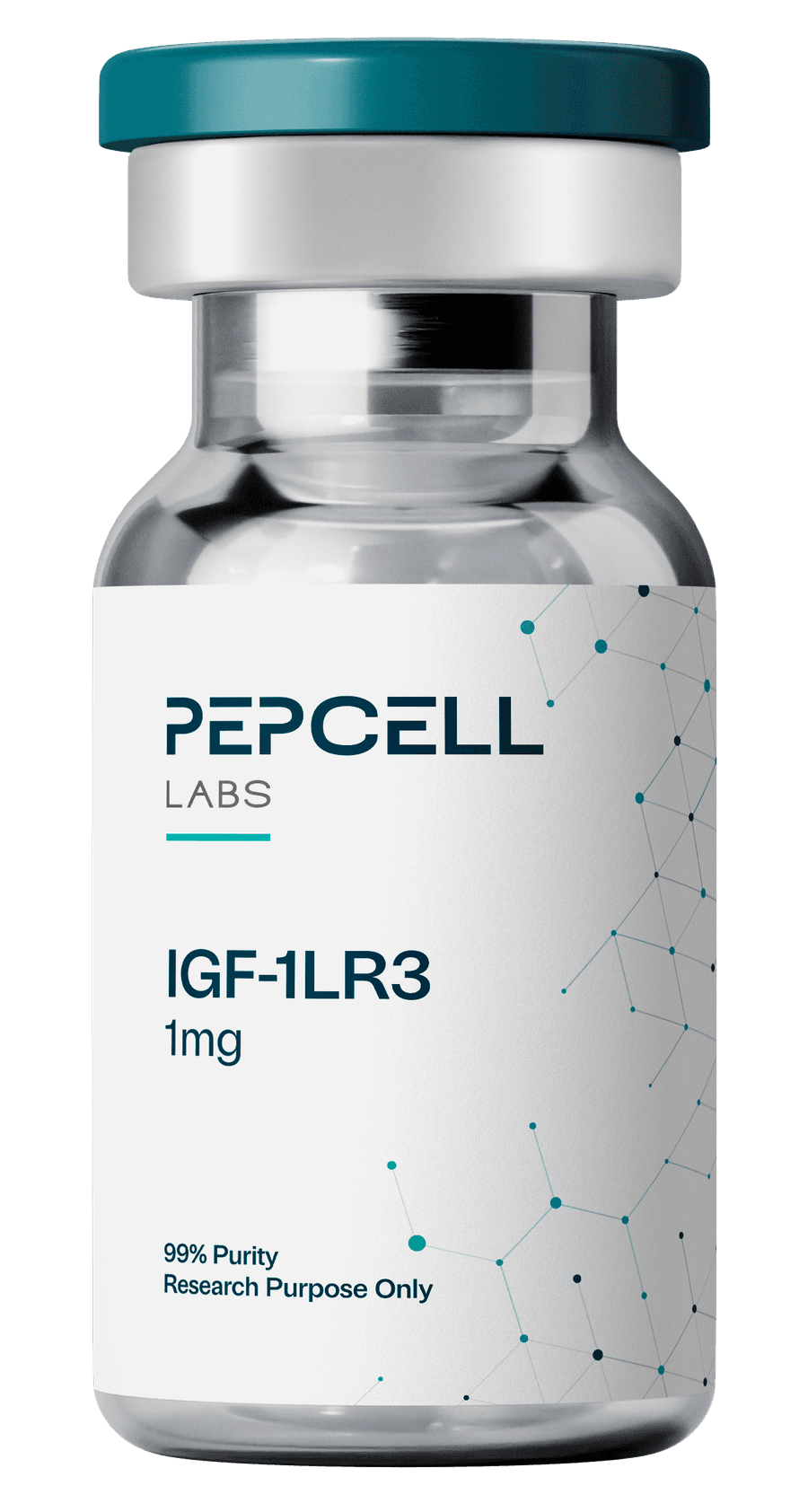
Size: 1mg
Growth Factor Analog Peptide
In stock · Ships same day · Free shipping over $150
Technical specifications
Molecular Profile
Long-acting 83-amino-acid analog of insulin-like growth factor 1.
Storage Requirements
Lyophilized (powder)
-20°C · stable long-term
Reconstituted / in solution
2-8°C · use within 30 days
IGF-1 LR3 (Long Arginine 3-IGF-1) is a synthetic 83-amino acid analog of insulin-like growth factor-1 that has been modified with an arginine substitution at position 3 (Glu3 to Arg3) and a 13-amino acid N-terminal extension peptide derived from methionyl-porcine growth hormone. These modifications dramatically reduce its binding affinity for IGF-binding proteins (IGFBPs 1-6), which normally sequester over 98% of circulating native IGF-1, effectively increasing its bioactive free fraction and extending its functional half-life from approximately 12-15 minutes to 20-30 hours. Published research in the Journal of Biological Chemistry and Endocrinology has documented that IGF-1 LR3 activates the IGF-1 receptor (IGF-1R) with comparable potency to native IGF-1, triggering downstream PI3K/Akt/mTOR and Ras/MAPK signaling cascades that drive protein synthesis, cell proliferation, and anti-apoptotic responses. Preclinical studies have demonstrated that IGF-1 LR3 promotes both muscle hypertrophy (enlarged fibers) and hyperplasia (new fiber formation through satellite cell activation and myoblast fusion), a distinction from most anabolic agents that primarily drive hypertrophy alone. Research in agricultural science has documented significant increases in lean tissue accretion and feed efficiency when IGF-1 LR3 is used in livestock models, while cell biology research utilizes it extensively as a growth factor supplement in serum-free cell culture media. The extended bioactive window of IGF-1 LR3 makes it the most widely used IGF-1 variant in research applications requiring sustained IGF-1R activation without the confounding variable of IGFBP sequestration.
Unlike most anabolic agents that drive only hypertrophy (larger existing fibers), IGF-1 LR3 has been demonstrated in preclinical research to promote genuine muscle hyperplasia — the formation of entirely new muscle fibers through satellite cell activation, proliferation, and fusion with existing myofibers. Published studies have documented increased muscle fiber number (not just size) following IGF-1 LR3 administration, mediated through the PI3K/Akt pathway's effects on myogenic regulatory factors MyoD and myogenin.
The Arg3 substitution and 13-amino acid N-terminal extension reduce IGFBP binding affinity by approximately 100-fold, liberating IGF-1 LR3 from the binding protein sequestration that normally limits native IGF-1's bioavailability to less than 2% of total circulating levels. Published pharmacokinetic research has documented a functional half-life of 20-30 hours compared to 12-15 minutes for native IGF-1, providing sustained IGF-1R activation that more effectively drives downstream anabolic signaling cascades over an extended time window.
IGF-1 LR3 activates PI3K/Akt signaling in skeletal muscle to enhance glucose transporter (GLUT4) translocation and amino acid uptake, while simultaneously promoting lipolysis in adipose tissue through suppression of lipogenic gene expression. Published research in agricultural and endocrine science has documented that this dual action effectively repartitions nutrients toward lean tissue accretion and away from fat storage, improving the ratio of muscle to adipose tissue gain during positive energy balance conditions.
Published research protocols reference subcutaneous or intramuscular administration daily. Store at -20°C until reconstitution.
Every batch is independently analyzed by a third-party laboratory for purity and identity before release. A batch-specific Certificate of Analysis (COA) is available for each lot.
Purity
99.6%
Lab
Janoshik Analytical Laboratory
Batch
IGF1LR-2025-001
Test Date
2025-03-25
Orders placed before our daily cutoff ship the same business day. Free shipping on orders over $150, with tracking emailed as soon as your order leaves our facility.
Shipment protection covers your order against loss or damage in transit — if a protected order is lost or arrives damaged, our support team will arrange a replacement or resolution.
For in-vitro research and laboratory use only. This product is not a drug, supplement, food, or cosmetic, and has not been evaluated by the FDA.
Use is restricted to qualified researchers and laboratories operating within all applicable institutional, legal, and ethical guidelines. By purchasing, you confirm you are acquiring this product solely for lawful research purposes.
Store IGF-1 LR3 lyophilized at -20°C for long-term preservation. Once reconstituted with bacteriostatic water or 0.1M acetic acid (the latter provides superior stability for IGF peptides), store at 2-8°C and use within 30 days. IGF-1 LR3 is more stable than native IGF-1 due to its modified structure, but the reconstituted solution should still be handled with care — avoid repeated freeze-thaw cycles and minimize room-temperature exposure.
Every batch of IGF-1 LR3 undergoes testing at Janoshik Analytical Laboratory using reversed-phase HPLC for purity verification and mass spectrometry to confirm the correct molecular weight reflecting the Arg3 substitution and 13-amino acid N-terminal extension. The modified residues are specifically verified to ensure proper sequence identity and IGFBP resistance. Amino acid analysis confirms the complete 83-amino acid sequence. Our batches consistently achieve 99%+ purity.
Reconstitute IGF-1 LR3 with bacteriostatic water or 0.1M acetic acid (preferred for enhanced stability) by slowly injecting along the vial wall. Do not shake — IGF peptides can aggregate with mechanical stress. Allow 2-3 minutes for complete dissolution, gently swirling if needed. For cell culture applications, sterile-filtered 0.1M acetic acid is the recommended reconstitution solvent. For subcutaneous research applications, bacteriostatic water is standard.
IGF-1 LR3 is sold for research purposes only and is not intended for human consumption. While native IGF-1 (mecasermin) has FDA approval for specific clinical indications, the LR3 modification is an investigational research variant. IGF-1 LR3 is widely used in cell biology research as a growth factor for serum-free cell culture systems and in preclinical studies investigating IGF-1R signaling. Always consult with a qualified healthcare professional before designing any research protocol.