Loading...
Loading...
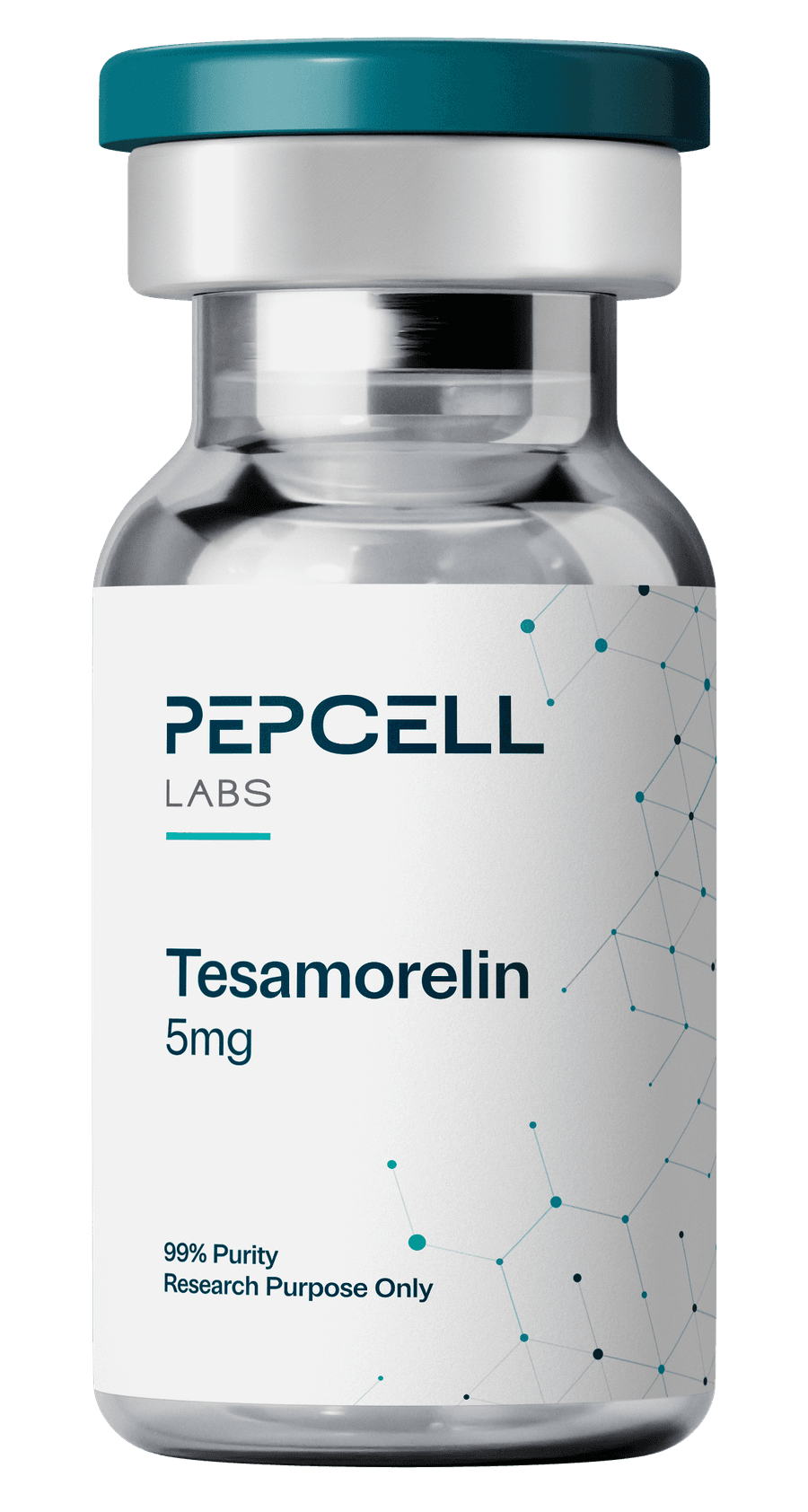
Size: 5mg
Secretagogue Peptide
In stock · Ships same day · Free shipping over $150
Technical specifications
Molecular Profile
Stabilized 44-amino-acid analog of growth-hormone-releasing hormone.
Storage Requirements
Lyophilized (powder)
-20°C · stable long-term
Reconstituted / in solution
2-8°C · use within 30 days
Tesamorelin (trade name Egrifta) is a synthetic growth hormone-releasing hormone (GHRH) analog consisting of the 44-amino acid sequence of human GHRH(1-44) with a trans-3-hexenoic acid modification at the N-terminus, resulting in a molecular weight of approximately 5,135 Da. This lipid modification enhances the peptide's resistance to dipeptidyl peptidase IV (DPP-IV) enzymatic degradation while preserving full agonist activity at pituitary GHRH receptors, producing sustained and physiological pulsatile growth hormone release through the Gs-adenylyl cyclase-cAMP-PKA signaling pathway. Tesamorelin is the only GHRH analog to have received FDA approval for a specific clinical indication — the reduction of excess abdominal fat in HIV-infected patients with lipodystrophy (approved in 2010 under the brand name Egrifta). Published clinical trial data in the New England Journal of Medicine demonstrated that daily tesamorelin administration produced an average 15-18% reduction in visceral adipose tissue (VAT) over 26 weeks, as measured by CT scan, along with significant improvements in trunk fat, waist circumference, and patient-reported body image perception. Beyond its FDA-approved indication, published research has investigated tesamorelin's effects on hepatic fat content (NAFLD), cognitive function in aging and HIV populations, cardiovascular risk markers, and peripheral neuropathy, with studies demonstrating significant reductions in liver fat and improvements in cognitive processing in MCI subjects. Tesamorelin's unique distinction as an FDA-approved GHRH analog with robust Phase III clinical trial data makes it one of the most clinically validated peptides available for growth hormone research, with well-established safety and efficacy profiles documented across thousands of study subjects.
Tesamorelin specifically targets visceral adipose tissue (VAT) through GH-mediated activation of hormone-sensitive lipase and suppression of lipoprotein lipase in abdominal fat depots. Published Phase III clinical trial data in the New England Journal of Medicine documented an average 15-18% reduction in visceral fat volume measured by CT scan over 26 weeks, an effect that was statistically significant and clinically meaningful. This VAT-specific lipolytic effect is more pronounced than that observed with direct GH administration, likely due to tesamorelin's preservation of physiological GH pulsatility.
Tesamorelin stimulates endogenous GH secretion through pituitary GHRH receptor activation while fully preserving somatostatin-mediated negative feedback, maintaining physiological GH pulsatile patterns rather than the sustained supraphysiological levels produced by exogenous rhGH. Published pharmacokinetic studies have documented that tesamorelin produces GH peaks within 30-60 minutes of administration that return to baseline within 3-4 hours, closely mimicking natural GHRH-stimulated GH pulses. This preservation of pulsatility is believed to contribute to its favorable metabolic effects while minimizing the insulin resistance associated with continuous GH elevation.
Beyond visceral fat reduction, published clinical research has documented that tesamorelin produces significant improvements in multiple metabolic markers including reductions in triglycerides (average 40-50 mg/dL decrease), improvements in total cholesterol-to-HDL ratio, and reductions in hepatic fat content by up to 37% in subjects with non-alcoholic fatty liver disease. Additional published studies have investigated tesamorelin's effects on cognitive function, demonstrating improvements in executive function and verbal memory in both HIV-positive subjects and aging adults with mild cognitive impairment.
Published research protocols reference daily subcutaneous administration. Store refrigerated at 2-8°C.
Every batch is independently analyzed by a third-party laboratory for purity and identity before release. A batch-specific Certificate of Analysis (COA) is available for each lot.
Purity
99.7%
Lab
Janoshik Analytical Laboratory
Batch
TESAMO-2025-001
Test Date
2025-03-23
Orders placed before our daily cutoff ship the same business day. Free shipping on orders over $150, with tracking emailed as soon as your order leaves our facility.
Shipment protection covers your order against loss or damage in transit — if a protected order is lost or arrives damaged, our support team will arrange a replacement or resolution.
For in-vitro research and laboratory use only. This product is not a drug, supplement, food, or cosmetic, and has not been evaluated by the FDA.
Use is restricted to qualified researchers and laboratories operating within all applicable institutional, legal, and ethical guidelines. By purchasing, you confirm you are acquiring this product solely for lawful research purposes.
Store Tesamorelin lyophilized at 2-8°C (refrigerator) for optimal preservation, as recommended for the FDA-approved Egrifta formulation. It can also be stored at -20°C for extended long-term storage. Once reconstituted with bacteriostatic water, store at 2-8°C and use within 14 days. The trans-3-hexenoic acid N-terminal modification is stable under standard refrigeration conditions. As tesamorelin is typically administered daily, reconstituted vials are consumed rapidly in most research protocols.
Every batch of Tesamorelin undergoes comprehensive testing at Janoshik Analytical Laboratory using reversed-phase HPLC for purity analysis and mass spectrometry to confirm the correct molecular weight (~5,135 Da) including the trans-3-hexenoic acid N-terminal modification. As an FDA-approved compound with established pharmaceutical reference standards, tesamorelin has well-defined quality specifications that our analytical methods verify against. Our batches consistently achieve 99%+ purity.
Reconstitute Tesamorelin with sterile bacteriostatic water by slowly injecting along the vial wall. As a 44-amino acid peptide, it may take 1-3 minutes to fully dissolve. Do not shake — gently swirl if needed. The FDA-approved Egrifta formulation uses sterile water for injection as its diluent. The reconstituted solution should appear clear and colorless; discard if turbid or discolored.
This research-grade Tesamorelin is sold for research purposes only and is not intended for human consumption. Tesamorelin has the distinction of being the only GHRH analog with current FDA approval, marketed as Egrifta for the reduction of excess abdominal fat in HIV-associated lipodystrophy. Pharmaceutical tesamorelin (Egrifta) is available only by prescription. Our product is manufactured for laboratory and investigational research use. Always consult applicable regulations and a qualified healthcare professional.