Loading...
Loading...
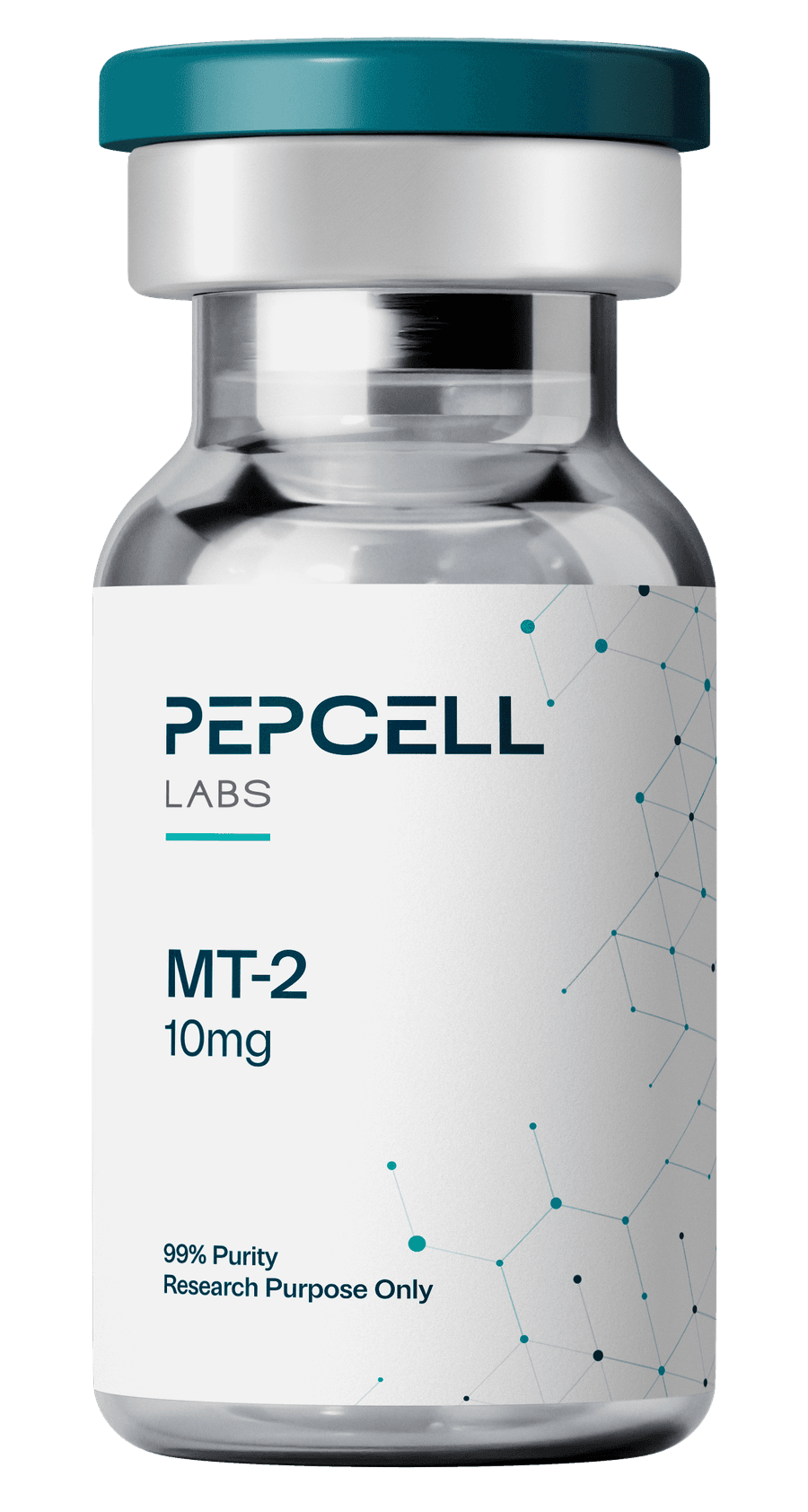
Size: 10mg
Peptide
In stock · Ships same day · Free shipping over $150
Technical specifications
Molecular Profile
Synthetic cyclic analog of α-melanocyte-stimulating hormone.
Storage Requirements
Lyophilized (powder)
-20°C · stable long-term
Reconstituted / in solution
2-8°C · use within 30 days
Melanotan II (MT-II) is a synthetic cyclic lactam heptapeptide analog of alpha-melanocyte-stimulating hormone (alpha-MSH) with the sequence Ac-Nle-c[Asp-His-D-Phe-Arg-Trp-Lys]-NH2 and a molecular weight of 1,024.18 Da, developed at the University of Arizona by Victor Hruby and colleagues. Unlike the linear alpha-MSH peptide which is rapidly degraded by proteases, Melanotan II's cyclic structure confers enhanced enzymatic stability and a prolonged biological half-life, enabling it to activate melanocortin receptors MC1R through MC5R with varying affinities. Published research in the Journal of Medicinal Chemistry and Peptides has demonstrated that MT-II potently stimulates melanogenesis through MC1R activation on melanocytes, producing increased melanin synthesis and skin pigmentation without UV exposure — the effect for which it is most widely studied. Beyond pigmentation, MT-II activates MC4R in the central nervous system, which published research in PNAS and the Journal of Sexual Medicine has documented produces significant enhancement of sexual arousal and erectile function through hypothalamic neural pathways, an effect that led to the development of the more selective MC4R agonist bremelanotide (PT-141, FDA-approved as Vyleesi). MT-II's activation of MC3R and MC4R in the hypothalamus also produces anorexigenic (appetite-suppressing) effects through suppression of NPY/AgRP orexigenic signaling and activation of POMC/CART anorectic neurons. The compound's broad melanocortin receptor activity has made it one of the most extensively studied peptides in melanocortin research, with published literature spanning pigmentation biology, sexual medicine, appetite regulation, and inflammatory modulation through the melanocortin anti-inflammatory pathway.
MT-II activates MC1R on epidermal melanocytes, triggering the cAMP/PKA/MITF signaling cascade that upregulates tyrosinase and related enzymes responsible for converting tyrosine to eumelanin, the dark pigment that determines skin and hair color. Published research by the University of Arizona group has documented significant increases in melanin density index and measurable darkening of skin pigmentation following MT-II administration, with effects persisting for weeks after discontinuation due to the slow turnover rate of melanin in keratinocytes.
MT-II activates MC4R receptors in the paraventricular nucleus and medial preoptic area of the hypothalamus, triggering a neurochemical cascade involving oxytocin and dopamine release that produces measurable increases in sexual arousal and erectile function. Published research in the Journal of Sexual Medicine documented significant pro-erectile effects in clinical studies, and this MC4R-mediated mechanism directly led to the development of bremelanotide (PT-141), which received FDA approval in 2019 as Vyleesi for hypoactive sexual desire disorder.
Through activation of MC3R and MC4R in the hypothalamic arcuate nucleus, MT-II suppresses the orexigenic NPY/AgRP neuron population while activating anorexigenic POMC/CART neurons, producing a net reduction in hunger signaling and food intake. Published research in endocrine journals has documented that melanocortin receptor activation is one of the most potent satiety signals in the central nervous system, and MT-II's anorectic effects have been extensively studied in obesity research models as part of the broader investigation of the melanocortin-4 receptor pathway in energy homeostasis.
Published research protocols reference subcutaneous administration in loading and maintenance phases. Store refrigerated at 2-8°C.
Every batch is independently analyzed by a third-party laboratory for purity and identity before release. A batch-specific Certificate of Analysis (COA) is available for each lot.
Purity
99.1%
Lab
Janoshik Analytical Laboratory
Batch
MT2-2025-001
Test Date
2025-03-20
Orders placed before our daily cutoff ship the same business day. Free shipping on orders over $150, with tracking emailed as soon as your order leaves our facility.
Shipment protection covers your order against loss or damage in transit — if a protected order is lost or arrives damaged, our support team will arrange a replacement or resolution.
For in-vitro research and laboratory use only. This product is not a drug, supplement, food, or cosmetic, and has not been evaluated by the FDA.
Use is restricted to qualified researchers and laboratories operating within all applicable institutional, legal, and ethical guidelines. By purchasing, you confirm you are acquiring this product solely for lawful research purposes.
Store Melanotan II lyophilized at -20°C for long-term preservation. Once reconstituted with bacteriostatic water, store at 2-8°C (refrigerator) and use within 30 days. MT-II's cyclic lactam structure provides enhanced stability compared to linear peptides, giving it good shelf life in both lyophilized and reconstituted forms. Protect from light, as melanocortin peptides can be photosensitive, and standard refrigeration between uses is sufficient for the reconstituted solution.
Every batch of Melanotan II is tested by Janoshik Analytical Laboratory using reversed-phase HPLC to verify peptide purity and mass spectrometry to confirm the correct molecular weight of 1,024.18 Da for the cyclic Ac-Nle-c[Asp-His-D-Phe-Arg-Trp-Lys]-NH2 structure. The cyclic lactam bond formation is specifically verified, as incomplete cyclization would produce a linear impurity with reduced biological activity. Our batches consistently achieve 99%+ purity.
Reconstitute Melanotan II with bacteriostatic water (BAC water) by slowly injecting along the vial wall. As a cyclic heptapeptide, it dissolves readily — typically within 1-2 minutes. Do not shake; gently swirl if needed. MT-II research protocols typically involve a loading phase followed by a maintenance phase, so calculate your reconstitution volume to provide convenient dose measurements across the full protocol duration.
Melanotan II is sold for research purposes only and is not intended for human consumption. MT-II was developed at the University of Arizona and has been the subject of numerous published clinical studies investigating its effects on skin pigmentation and sexual function. Notably, MT-II research directly led to the development of bremelanotide (Vyleesi), which received FDA approval in 2019. Always consult with a qualified healthcare professional before designing any research protocol.